November 17, 2015

2015 Take Back Halloween Costume Contest

This year, I entered my young Queen Victoria costume in the fourth annual, costume contest hosted by Take Back Halloween!  And, you'll never guess what happened next.........My entry was chosen for the "Best Queen" category!!

Official banner:


Description:
This exquisite costume began life as a discarded 80s prom dress, which Anneliese transformed into queenly attire in a matter of hours the weekend before Halloween. It will perhaps not surprise you to learn that Anneliese is an aspiring costume designer; her talent, skill, and eye for balance and detail are superb.  ~ Take Back Halloween!

I am absolutely speechless - what an honor and surprise, especially when there were so many, fabulously historical & fun costumes entered!  Make sure to check them all out, here: 2015 Costume Contest Winners2015 Costume Contest Official Facebook Album.

November 16, 2015

Costume Design Challenge: Day Four - Seven

I've joined the November Costume Design Challenge hosted by the famous & fabulous Lauren of Wearing History!  And you can too by clicking on link above or official banner on the sidebar...

Part I was posted last week, so here's part II featuring challenges four through seven.  Let the designs begin!


Challenge #4: On the Farm


Please click for larger image.

Definition:  Farm (noun) - A tract of land, usually with a house, barn, silo, etc., on which crops and often livestock are raised for livelihood.

Design:  Immediately I thought a hard-working, pioneering woman on the edge of the frontier in the 1870s.  Through blood, sweat and tears, she farms and soldiers on for a better life.  Her calloused hands are soft enough, however, to love, caress and dearly embrace her children.  An all-covering apron with deep pockets is a must over her sturdy work dress, perhaps made from a madder-dyed, small print calico.  Faded sun spots, patches and dirt are her badges of labor and toil.  A practical slat bonnet with a long curtain that passes her shoulders and a small ruffle for a pretty, feminine touch shields her face from the beating sun.

The perfect painting inspiration:

The Sick Chicken by Winslow Homer, c.1874
(Image via: National Gallery of Art, Pinterest)

Practical slat-bonnet with pretty, ruffly details:

Sunbonnet, c.1850
(Image via: MET, C.I.53.72.24)

Dress and apron inspiration:  Though the dress' style is outdated for the 1870s, I really like the color scheme!

Dress with apron, madder-dyed, c.1840
(Image via: Museum-Digital)

I also prefer the full apron style, as opposed to the half apron above:

Pinafore Apron
(Image via: BurdaStyle)


Challenge #5: At the Ascot Races

Please click for larger image.

Definition:  Ascot (noun) - (1) A tie or scarf with broad ends looped to lie flat one upon the other and sometimes held with a pin; (2) A town in South East Berkshire, South England, noted for its horse-race meetings; especially Royal Ascot, a fashionable, four-day, horse-racing event held in June.  Members of the royal family attend some of the races, and many people go there for social reasons rather than sport. 

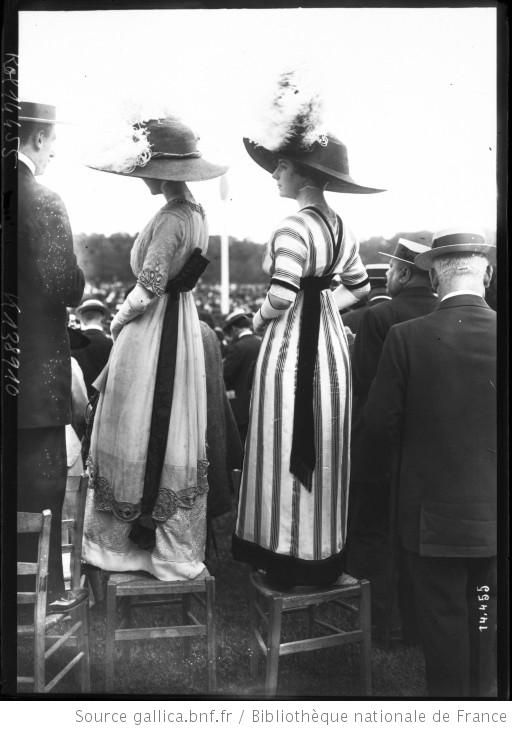
Design:  Such a prestigious event as the Royal Ascot deserves a fashion forward, sporty and stripey, early-1910s ensemble!  Not to mention, as tradition dictates, for the third day, called Ladies' Day, a matching striped, beribboned and feathered hat of enormous proportions is a must.  

Inspiration from past races:  Stripes sure were in style!

Fashions worn at the Auteuil Races, 1911.
(Image via: Source)

(Image via: Pinterest)

When I came across this fashion plate, I immediately knew the look I was going for...the large hat, chic dress, parasol:

1910 Fashion Plate
(Image via: Source)

THE dress inspiration:  Black and white stripes for the win!

Dress, c.1908-1915, worn by Rosamund Anstruther,
Mrs. Edward Windsor Hussey (1877-1958)
(Image via: National Trust Collections)

Like the black drapery to break up the stripes...

Ensemble, c.1912–15
(Image via: MET, 2009.300.245a–c)

Hat inspiration:  Just needs a larger brim...and maybe some feathers!

Straw hat with striped silk bow from Ladies Home Journal, March 1912
(Image via: Fashion a Hundred Years Ago)


Challenge #6: The Opera Singer 


Please click for larger image.

Definition: Opera (noun) - An extended dramatic composition, in which all parts are sung to instrumental accompaniment, that usually includes arias, choruses, and recitatives, and that sometimes includes ballet; Singer (noun) - A person who sings, especially a trained or professional vocalist.

Design:  We're leaving the comfort zone of mid-18th to mid-20th century fashion for the 1550s.  Clothed in iridescent blue and silver brocade, encrusted with precious gems and abundant pearls woven throughout both her dress and hair, the opera singer's costume is as rich and heavenly as her voice.  

THE inspiration portrait: I was having trouble settling on a look until I came across this lavish and queenly portrait of Isabella di Cosimo Medici!   

Portrait of Isabella di Cosimo Medici by Alessandro Allori, c.1555-1558
Kunshistorisches Museum, Vienna
(Image via: http://starlightmasquerade.com/PortraitGallery/Florentine/Florentine5.htm)

A similar dress:  Though I do like the sleeve treatment better here...

Portrait of a Woman with a Dog by Veronese, c.1560-1570
Museo Thyssen-Bornemisza, Madrid
(Image via: Museo Thyssen-Bornemisza)

Brilliant brocade inspiration: 

Gold Embroidered Royal Blue Chenille Brocade
(Image via: Time After Time Designs)

The opulence I imagined:  Talk about abundant peals and precious gems!

Agnetha, dress constructed with 12 Rubies, 114 Garnets, 8 Sapphires,
10 Moonstones, 1158 fresh water Pearls, 698 Swarovski crystals & 53 Amethysts.
(Image via: Enchanted Doll)

Hair and jewelry, featuring more strands of freshwater pearls: 

Detail from Las infantas Isabel Clara Eugenia by Catalina Micaela, c.1575
(Image via: Tumblr)


Challenge #7: Revolution

Please click for larger image.

Definition: Revolution (noun) - (1) A sudden, radical, or complete change in something; (2) An overthrow or repudiation and the thorough replacement of an established government or political system by the people governed.

Design:  Who's there?  French Revolution!  (Gold star if recognize the reference...)  Not only were the 1790s marked by revolutionary change in the socio-economic and political spheres, fashion underwent a dramatic, columnar shift in silhouette.  It's off with the panniers and fully-boned stays, and on with the soft, natural lines of the chemise a la reine and empire waist.  Throw on a bright red, Spencer jacket with a jaunty, little peplum, and a tricolore cockade to show your allegiance.  Vive la France!

Step one - the dress: This plain, white cotton, chemise dress is the perfect Neo-classical start:

Chemise a la reine, c. 1797 - 1805
(Image via: V&A Collection)

Step two - the jacket:

KCI Pink taffeta drawstring jacket, c. 1790
(Image via: Source)

I absolutely love the shape of this spencer from the neckline, to the sleeves, and down to the flounce!

Late 18th century jacket.
(Image via: MET, 2010.151)

Step three - accessorize:  What's better than one tricolor cockade?  Two tricolor cockades, mounted on a pair of mules!

Heeled lady's mules of yellow figured silk and cream-colored leather,
ornamented with silk self-fringe tricolor cockade, c. 1792.
(Image via: Pinterest)

Please visit my November Costume Design Challenge Pinterest Board for all of my inspiration images, as well as where you will find the links to the original image sources.  Thanks for reading!


November 12, 2015

Costume Design Challenge: Day One - Three

I've joined the November Costume Design Challenge hosted by the famous & fabulous Lauren of Wearing History!  And you can too by clicking on link above or picture below:

(Image via: Wearing History)

For each day in the month of November, there is a provided a "challenge scene" or "character" for participants then to costume design away.  Whether the entry be a sketch or photo collage, or even both, the object is creativity.  Inspiration can be pulled from any time period - past, present or future, fantasy or reality, historical or not - "no limits," Lauren writes!  While the challenge is really set up for Instagram (which I am not on, yet) - Wearing History's Instagram Feed - she also extends the invitation to Facebook, blogs (which I have chosen), et al.  So, I hope that you will decide to join in too, because it's simple and fun to play!

Here were the first week's challenges:


I am joining in a little late, so there probably will be several days of catch up...and blogging, as usual, probably also will be behind...While I really should be sharpening the pencils, and my drawing skills, for the sake of time and fun, I will be creating photo collages for all of my challenge entries.  Ideas and costume designs, themselves, may come quickly; but, the paper part does not always.  So, without further ado, the designs...  


Challenge #1: The Femme Fatale 

Please click for larger image.

Definition:  Femme Fatale (noun) - an attractive and seductive woman, especially one who will ultimately bring disaster to a man who becomes involved with her.

Design:  Immediately I thought of glamour of Old Hollywood, and the slinky bias-cut, shimmery, silken evening dresses of the 1930s.  In a poison or bright emerald green, silk satin or  fabric, the gown would have a dangerously low-cut back with generous drapery.  

I love the top half of this dress, coupled with the dramatic pose:

Augusta Bernard, photographed by George Hoyningen-Huene, 1933
(Image via: Pinterest, Holden Luntz Gallery)

Add the swoop of the bottom half & train of this gown:

Silver Satin Evening Gown, 1930s
(Image via: Augusta Auctions, Lot 214)

And a pair of killer, glitzy, but not gaudy, heels:

Green silk with gold leather trim, labelled Oppenheim Collins, mid-1930s.
(Image via: Pinterest)


Challenge #2:  The Gothic Thriller 

Please click for larger image.

Definition:
 Gothic (adjective) - Of or relating to a style of fiction that emphasizes the grotesque, mysterious, and desolate; Thriller (noun) -  one that thrills; especially a work of fiction or drama designed to hold the interest by the use of a high degree of intrigue, adventure, or suspense.

Design:  I had a hard time deciding between the fashions of the early Victorian period (think the 1840s, the Brontë Sisters, Edgar Allan Poe) and those of the late Victorian period, which, in the end, won out.  Dressed in an all black, bustle gown with a sleek line, perhaps with a glimmer of gold on her boots and a narrow trickle of blood red trim in the front, an ominous figure can be seen.  You can hear the slight rustle of her heavy train as she glides past, shrouded in mystery, but her face is kept from your view by a large parasol.

This dress, period:  It's exactly what I had in mind to the sleek, fitted form, cascading train, and even the parasol!  I would change the front though...

Mourning ensemble, c.1870-72
(Image via: Metropolitan Museum of Art, Costume Institute)

Look at these gilded boots!  I am inspired by the careful curves and complimenting scallops:

Side-button boots, c.1870-79.
(Image via: FIDM Musem & Galleries)

If you did happen to catch a glimpse of my mystery lady's front, you would be greeted by a tall, top hat, every bit as elegant as her dress, trimmed with a large pair of wings, black of course.  Her face, however, would be still be hidden with a long, full mourning veil.

Ladies' Victorian Silk Top Hat, c. 1880s.
(Image via: Etsy - Nehelenia)
  

Challenge #3:  She Travels by Train

Please click for larger image.

Definition: Travels (verb) -  to go from one place to another, as on a trip or journey; Train (noun) - a series of connected railroad cars pulled or pushed by one or more locomotives.

Design:  Vintage suitcase.  1940s suit.  Mother with child in hand.  Those were the first thoughts that came to me when I read the prompt.  I can just see that mother now, suitcase in one hand and child in the other, trying to keep everyone and everything together as they make their way through the busy train station.  Mom wears a matching, grayish-brown, suit jacket with the coordinating skirt, and a smartly perched hat.  The four-year-old daughter, dressed in a red, scalloped coat dress with shiny, patent leather, Mary Janes and tall, white socks, steps in sync with the soft click of her mother's modest pumps.  Each one carries a travel suitcase, tan with several bands of brown lines, and the little one adds a skip to her step, eagerly anticipating her first train ride.

How precious is this?  A little one with a suitcase just about as big as she is tall:

Railway platform at Bristol, England,
photographed by George W. Hales, 1936.
(Image via: Tumblr)

Lady on the right in red:  My idea of the ideal shape and style for the 40s suit.

Sewing pattern: Misses two piece suit dress, size 14, 1940s.
(Image via: https://www.pinterest.com/pin/404409241518356925/)

Little girl in the red coat on the bottom right:  What an adorable coat dress!  The scallops and peter pan collar add the perfect touch, not to mention the precious matching hat and shoes.

Sewing pattern: Advance 5928, toddler size four, 1940s.
(Image via:  Etsy - AdeleBeeAnnPatterns)

Please visit my November Costume Design Challenge Pinterest Board for all of my inspiration images, as well as where you will find the links to the original image sources.  Thanks for reading!

November 10, 2015

A Young Queen Victoria

"I am young, but I am willing to learn, and I mean to devote 
my life to the service of my country and my people."
~ The Young Victoria (2009)


Perhaps it is no secret that my favorite monarch in British history is Queen Victoria.  Ever since I saw Jean-Marc Vallée’s film, The Young Victoria (2009), I have been smitten with the powerful, outspoken and imposing queen and empress who stood at no more than five feet tall.  Therefore, it only made sense to pay homage to her by dressing as the young queen for this past Trick-or-Treat Day through the village & Halloween.  

Take a look at this neat, early 19th century, Chinese portrait of Queen Victoria
& more on my God Save the Queen Pinterest Board, featuring all things Queen Victoria!
(Image via: Pinterest)


Inside & Out

Maybe not the most historically accurate royal attire, but oh so fun to wear!  Two nights before the Trick-or-Treat event in the village, I pulled out this refashioned, 80s prom dress from the back of the closet, and literally had hours to transform a sad, wadded up, bundle of fabric into a dress fit for a queen.  I originally received the pale, pink prom dress and lace back in high school in exchange for helping sort the costume basement of a local community theater.    Since then, after it had graced the stage as Emma's "Protest" Dress in the Finalle of Doctor Dolittle (2013), the dress has sat in the closet waiting to be given a face lift.

The inspiration - this portrait by Franz Xaver Winterhalter:

Portrait of Queen Victoria by Franz Xaver Winterhalter.
(Image via: Women's Fashions of the Victorian Era: From Hoop Skirts to Bustles - 1837 - 1901)

First, I gathered my mid-century undergarments - white silk stockings, modesty petticoat, flounced bustle pad, plain petticoat, tucked petticoat - as well as the pink, striped hoop I made for theater.  Trying the dress over all of the undergarments, I took note of all of the alterations and repairs needed.  Repairing rips in the lace, entirely redoing the sleeves and altering the bodice took an entire night.  I then added the trimmings on the bodice and sleeves by hand:

Close up of the bodice with lace, ribbon and pearl brooch.

Inspiration for the broach taken from this portrait in the Royal Collection:

Portrait of Queen Victoria by Franz Xaver Winterhalter, 1845.
(Image via: http://bornin1808.blogspot.com/2013/05/celebrating-anniversary-of-queen.html)

Then, I tackled the royal sash.  Using a scrap of dark blue, crepe back satin left over from a previous project, I cut four strips about 30 inches long by 6 inches wide, with only an inch of fabric to spare.  Seamed and pressed the centers with a generous allowance; and, pinning right sides together, seamed the sides, leaving about three inches open to turn.  Finally, after a good pressing and careful top stitching right at the edge, the royal sash was ready to wear.  (And then, I ran off to play Snow White in Spirits of the Past...)

Pinning my royal sash from right shoulder to left hip.


Inspiration for the sash (and also my hairstyle) came from this portrait: 

Portrait of Queen Victoria by Robert Thorburn, 1844.
(Image via: http://bornin1808.blogspot.com/2013/05/celebrating-anniversary-of-queen.html)

Next came my one and only royal order:  Made from white, double faced satin ribbon and a cameo broach.  Hand-stitched in between Spirits of the Past scenes.  (For truly fantastic reproductions of royal orders, check out Gina's tutorial at Beauty from Ashes: Royal Family Orders Round 2 - what an inspiration!)

Original Badge of the Order of Victoria and Albert (first class):

Badge of the Order of Victoria and Albert (first class), c. 1860-2.
(Image via: Royal Collection Trust)

My version: While most royals wear their orders and decorations on their shoulders at formal events, I chose to pin mine to my sash.


Finally, I accessorized with a small portrait of Prince Albert:  Made from the same, white, double faced satin ribbon, narrow, black velvet ribbon, metal frame, card stock, mod podge, and a printed portrait of the Prince Consort.  On such short timing, I thought the portrait looked quite official! 

The original portrait painted by Charles Brocky:

Portrait of Prince Albert of Saxe Coburg & Gotha by Charles Brocky, 1841.
(Image via: https://www.flickr.com/photos/42773258@N08/7263882160/in/photostream/)

My miniature, pinned to royal sash:


Adding a vintage, paste necklace, paste broach, opera length gloves with pearl wrist fastenings, and paste crown completed the royal look!


Completed Project Shots

"We are not interested in the possibilities of defeat. They do not exist."
~ Queen Victoria


With shorter days, it was a race against the setting sun to get my royal attire photographed.  The photo shoot took place in the picturesque West Garden of the George Eastman Mansion (same place as my senior year photos).  My photographer, Maria, the sister, had less than half an hour to work her magic, and she sure outdid herself. *All photographs courtesy of Maria - thanks a million!* 

Series the First:  At the Wall


Series the Second:  On the Grounds


Series the Third:  By the Door


Project Review

Year:  1840s-1850s

Materials:  Pink polyester (80s prom dress), several types of white lace, dark blue crepe back satin (left over from a previous project)

Notions:  Spool of high quality, double faced, red satin ribbon; white, double faced satin ribbon; narrow, black velvet ribbon; narrow elastic; buttonhole twist thread in several colors; several buttons & broaches

Cost:  Mostly cobbled together from the stash, only had to buy the tiara, white, satin ribbon, narrow, velvet ribbon, mod podge (and brush) & white, pointed toe flats.  (Total cost estimation: $50)


Ad Victorian.  For victory.

We ❤︎ Our Patrons

Like what you see here, and want to support future blogging and educational programming? Consider becoming a Patron - click on the button below to unlock exclusive content, bonus blog posts, and more! Every contribution makes a big difference, thank you!