Showing posts with label Mourning. Show all posts

July 27, 2018

Battles, Bonnets & the Ball

Last weekend for the annual Civil War Re-enactment & Encampment at the Genesee Country Village & Museum (known simply as the "Mumford" event), I had the chance to do something I never have done before...when I heard that Anna Worden Bauersmith of If I Had My Own Blue Box, a prolific author & period straw milliner extraordinaire, was looking for a shop assistant, I jumped at the opportunity!  

Insurance office turned millinery shop for the Civil War Weekend


The Millinery Shop

Anna Worden Bauersmith is Genesee Country's local celebrity, and beyond all the fame, she's one of the nicest, most talented and well researched people that I know.  For several select events during the museum season, Anna offers something really special and unique to the experience of village visitors and participants alike by interpreting and demonstrating the art of period millinery.  This past weekend, she set up shop in what is usually the insurance office, transforming the space into a well-stocked millinery shop.   


Boxes of fine ribbons and accessories galore lined the mantle and filled the nearby shelf: 


Four tables were set up to display a wide sampling of fashionable bonnets and hats, evening headdresses, and more practical corded sunbonnets and winter hoods:  (Do see her blog post on the event's millinery for specifics, here: Adding New Millinery to My Etsy Shop

Special this year were several woven straw examples
& the highly fashionable Mousquetaire hat

There was even a mourning display featuring a woven straw bonnet (left), decorated straw hat (right), quilted hood trimmed in mink (top), various ribbons and pinked, black silk trim samples (bottom):  


All together, the display and the entire shop, discussed in more detail in the Before and After blog post, looked spectacular!  It would be worth attending the event just to see everything and to meet Anna in person.  In fact, this year marked her personal, 20th anniversary of the Civil War event - and I was beyond thrilled to celebrate with her. 

Here's a picture of the before:

From insurance office...
Notice Mr. Stowe busy at work in the back room.

And a view of the after:

...To millinery shop!


Saturday, June 21st


As for the running of the shop, the first day was definitely the warmer of the two in temperature.  Still a pleasant day, the morning and afternoon flew by between sewing and interesting conversations.  There was a steady stream of visitors, though we were never really overwhelmed. 

All three of us at work.
(Photograph courtesy of Judy J.)

One of the greatest perks of assisting in the shop was that it was a favorite stop for many familiar and new friends!  I hadn't seen many of these reenactors since last year's event, and enjoyed meeting others in person for the first time.

Coming in as customers, leaving as friends.
It was also interesting to watch potential customers try on the various hats and bonnets, seeing which styles and colors flattered the wearer best.  There's certainly an art to both the making and wearing of millinery!

Speaking of which, it was so exciting to see one of the straw bonnet forms being finished from the lining to the curtain and ties:

Basting silk and net together for the bonnet bavolet.

I worked off and on a double ruffle cap all weekend...still have to finish whipping the frills and adding any trimmings:

A rare picture of me actually sewing!
(Thanks Judy J.)

Something else that I also really look forward to every Civil War event is the evening dance.  There's nothing like getting all dressed up and having your hair styled by a good friend.  Allison was so kind to assist me this year, and I continue to be amazed by her historical hair styling skills!

Historical hair styling chain.

Obligatory hair photo - thanks Allison!

I joined my friends and the Flint Hill Dance group for some pictures before the ball.  Stephen orchestrated his annual group shot on the Livingston-Backus Porch, taking such care to pose us all so elegantly for a tintype: 

The modern color picture.
The 20-second exposure by the one and only Michael Rhodes!


And, a picture with Allison!  We were half joking that this is proof that we actually know one another as we're usually on opposite ends of the camera...She looked absolutely stunning in that color and fabric! 


(Photograph courtesy of Stephen S.)

After dancing the night away, I retired to the Foster-Tufts House, very happily out of the rain.  It poured all night.  


Sunday, June 22nd

The next morning it was back to the shop for another day of sewing, interpreting and pleasant conversations.  All of the rain the night before made for a comfortable day, and the visitors really responded to the display and engaged with us, which made all of the efforts worthwhile.   

Taking care of business, day two in the millinery shop.
(Photograph by Trudy W., via Facebook)

Much like the day before, many of our friends, both new and familiar, stopped in to say hello and conduct business with the proprietress.  At one point, I had to giggle as life continued as if nothing was amiss while the village battle raged outside! 

Company during the village's afternoon battle.

And that concludes this Civil War weekend report on what was one of the greatest highlights of the 2018 museum season!  I simply cannot thank Anna enough for taking me on as her millinery shop assistant!  'Till the next time... 

October 31, 2017

Sleep That Makes No Show for Dawn - 1860s Photoshoot

"A long, long sleep, a famous sleep
That makes no show for dawn
By stretch of limb or stir of lid, —
An independent one."
- Emily Dickinson, Poem 139


A Happy and Spooktacular Halloween to all!  Since I was unable to finish my fancy dress costume this year, I thought it very appropriate to finally share this long-awaited, 1860s photo shoot that Maria, sister and photographer, and I did last August, before I left for college.  All of the construction details for the dress and petticoat can be found here: Inside & Out: DNA Dress and Hoop, and the fancy dress cap here: Lace on My Clothes & Bows on My Caps.  

In the photographs, my dress is worn over a mid-19th century chemise, drawers, under-petticoat, small support pad and 90" cage with two tucked petticoats to smooth the silhouette.  A large, striped, silk cravat bow, silk belt with a mother of pear buckle, and beribboned, fancy dress cap complete the look.  


Completed Project Shots

First and foremost, I must thank my talented sister and photographer, Maria, for all her time and attention to the details!  Without her, none of these photo shoots would be possible, and for that, among many other reasons, I am overwhelmingly grateful.  Here's to her, and for allowing me to share her work!  *All photographs courtesy of Maria M.* 


Because I could not stop for Death —
He kindly stopped for me —
The Carriage held but just Ourselves —
And Immortality.


We slowly drove — He knew no haste
And I had put away
My labor and my leisure too,
For His Civility —


We passed the School, where Children strove
At Recess — in the Ring —
We passed the fields of Gazing Grain —
We passed the Setting Sun —


Or rather — He passed Us —
The Dews drew quivering and chill —
For only Gossamer, my Gown —
My Tippet — only Tulle —


We paused before a House that seemed
A Swelling of the Ground —
The Roof was scarcely visible —
The Cornice — in the Ground —


Since then — ’tis Centuries — and yet
Feels shorter than the Day
I first surmised the Horses’ Heads
Were toward Eternity —


Poem is "Because I Could Not Stop for Death" by Emily Dickinson.


Mount Hope Cemetery 

Before ending this post, I'd like to highlight and give a little background on the location of our shoot.  This may sound slightly morbid to some, but I personally find cemeteries not only historically significant, but incredibly peaceful places to walk around and collect my thoughts.  I have spent many afternoons wandering around Rochester's Mount Hope Cemetery, quietly reflecting and exploring the 200 acres and 14 miles of roads, hills and valleys, and paying respects to the 350,000 sleeping for eternity.  

The Gatehouse, 1874.

Described in the following introduction, by the Friends of Mount Hope Cemetery, the nonprofit organization devoted to the preservation, restoration and public appreciation of the culturally significant site:
"Dedicated in 1838 in Rochester NY, Mount Hope is America's first municipal Victorian cemetery.  Set in a picturesque landscape shaped by retreating glaciers, the cemetery features more than 80 mausoleums, soaring Egyptian obelisks, winged angels of mercy, a Florentine cast-iron fountain, two stone chapels in Gothic Revival style, a Moorish gazebo, and infinitely varied tombstones marking 350,000 graves across 196 acres." - The Friends of Mount Hope Cemetery

One of two chapels and original crematory, 1862.

In terms of history, Mount Hope Cemetery truly offers something for everyone.  From Rochester and Erie Canal history, to Victorian symbolism and architecture, the Revolutionary and Civil Wars, Jewish and African-American history, many notable leaders, inventors, prominent families, artists, architects, abolitionists and women's rights activists were laid to rest there.  

Perhaps among the most famous are Susan B. Anthony:


Fredrick Douglas:


Nathaniel Rochester and family: 


As well as dozens of others, including Daisy Marquis Jones, Alexander Milliner, George Washington's drummer boy, Dr. Charles T. Lunsford, the first African American physician in Rochester, the children of Buffalo Bill Cody, and William, and later Hannah Carter, the first buried on the site:


Veterans of all the major American wars are represented, including specific Civil, Spanish-American and World War I sections and a D.A.R. monument.  

Row by row in the Civil War plot.

And, finally, you'll find several of the families from the houses preserved at the Genesee Country Village & Museum: 

Rebecca A. Fitzhugh, wife of Dr. Fredrick F. Backus, of the
Livingston-Backus House (at the Genesee Country Village & Museum)

Dr. Frederick F. Backus, prominent Rochester physician and politician.

The services at Mount Hope Cemetery go beyond burials, offering many opportunities to volunteer in landscaping, gardening, and gravestone maintenance and repair.  Under the generous care of the Friends of Mount Hope Cemetery and donors, free genealogical research, public lectures and tours, and printed works, including several books and a quarterly newsletter, titled the Epitaph, are available.  So, if you're ever in Rochester, make sure to visit my favorite local cemetery and historical treasure! 


June 28, 2017

Mourning Jane Austen at 1812 Weekend

"My mother is preparing mourning for Mrs. E. K.; she has picked her old silk pelisse to pieces, and means to have it dyed black for a gown - a very interesting scheme" - Jane Austen to Cassandra, October 7, 1808

Commemorating the 200th anniversary of Jane Austen's death.
December 16, 1775 - July 28, 1817


200 years ago, on this day, July 28th, one of the greatest English novelists, Jane Austen, left this world for another.  Her legacy, however, lives on through masterpieces like Sense & Sensibility (1811), Pride & Prejudice (1813), Mansfield Park (1814), Emma (1815), Northanger Abbey (1817), and Persuasion (1817), among other works.

So I thought it fitting to write about this past weekend - the annual War of 1812 and Jane Austen Weekend - my favorite event at the Genesee Country Village & Museum!  In fact, it appears that I've dedicated an entire post to it for the past couple of years:  1812 Weekend in Genesee Country (2016) and 1812 Weekend at the Genesee Country Village (2015).  


Friday, June 23rd - Setting Up Shop

The dressmaker at work.

To commemorate the 200th anniversary of Jane Austen's death, the dressmaker and I put together a special mourning display.  On the Wednesday before the event, Rhonda contacted me with the brilliant idea, and that Friday, two days later, we were setting up her shop.  Together we collected every scrap of ribbon, lace and trim, fine silks and wools, accessories and the latest fashion plates a lady might need to remain fashionable at every stage of mourning.  Two hours and a laundry basket, several various bags and bonnet boxes later, the shop was arranged for the weekend.  

On the main work table, draped in black sateen, the dressmaker offers the finest black, silk ribbon, reticule and leather gloves for full morning, as well as a checked, silk bonnet, ombre ribbon, length of white china silk, and dainty cotton gloves for half morning.  Propped up on an early copy of Sense & Sensibility and Northanger Abbey, the silhouette of Jane Austen is framed for all to see.  


In the later years of the Regency Period, the British observed quite a bit of royal mourning.  In the Fall of 1817, Princess Charlotte died after giving birth to a stillborn child.  A year later, in 1818, the Queen Consort Charlotte died, as well as King George III in January of 1820, ending the Regency Era.  Six days later, the Duke of Kent passed, leading the country into double mourning.  Periodicals like Ackermann’s Repository and La Belle Assemblee would have printed the latest fashions for mourning:  

Mourning fashion plates from Ackermann's Respository.

Right above the table is fully stocked shelf with all sorts of antique lace lengths, ribbons and trims, millinery flowers, gloves and other small accessories.  As well as several lengths of silks of various weights in black, white, greys, and even a purple and grey plaid taffeta for half mourning.


Mourning customs were observed to various degrees by class, and dictated not only what was socially appropriate behavior, but gave a dress code that divided the mourning period into two distinct stages - full and half mourning.  In the first period of mourning, black, the traditional color that dates back to the Romans, was the preferred color, with crape or bombazine, a silk with a matte finish, being the indicator fabrics.  In the half mourning period that followed, more colors were introduced with greys, purples and even white. 

Fabrics, trims and millinery ribbons for all stages of mourning.

While the wealthy could afford to make separate wardrobes for mourning, most people transformed existing garments for mourning, covering bonnets in crape and dyeing old dresses.  Even the poor made attempts to follow mourning customs with a black ribbon or armband.  

My favorite part was arranging the shelf!
We really liked the idea of cascading ribbons
and trims from the band boxes.

To complete the left side of the shop, a gown (which you may recognize as the one that Samantha made!) suitable for half mourning hangs with a double ruffle chemisette.  

Half mourning dress with a double ruffle chemisette,
central work table and millinery shelf.

On the other side of the shop, we draped the mirror with black point d'esprit, and the chest with a length of black silk.  Several grey wool dress lengths and a white cotton lawn sit, waiting to be made into mourning dresses.


On the other work table, also draped in black, we arranged an undergarment display for the visitors.  The items included a shift, long pantalettes, three pairs of stockings, short stays, long stays, and an antique petticoat.  


My new short stays and an antique petticoat from my collection.
It features two scalloped flounces with gorgeous white work -
a very, very lucky find!

Three pairs of stockings - plain cotton,
ribbed silk, and an antique set of clocked stockings.

Lastly, in the middle of the shop, where the dressmaker usually works, hence the small stand with personal belongings, we filled the scrap basket with grey and purple calicos, as if several dresses had already been sold.


With the shop ready to go for the weekend, the dressmaker and I locked up and had a lovely dinner with her neighbor, Kate from the apothecary shop.  Having only exchanged brief hellos in the past, it was a great pleasure to get to know Kate.  She is a fantastic lady with a true passion for historical education and appreciation for a multi-cultural past.  It really made day, if not the week, to sit in the presence of such wonderful company as Rhonda and Kate!  I sure hope that she will return again next year.  

Kate, the apothecary, and Rhonda, the dressmaker.


Saturday, June 24th - Event Day One


The dressmaker and I arrived bright and early in the morning to start our days.  (My family and I had the privilege of hosting and the pleasure of her company for the weekend as her carriage ride would be quite a distance more than mine.  We all like Rhonda so much, and it is such an honor to call her friend!) 

The dressmaker in her shop.
Photograph by Judy J.

One of the much anticipated festivities of the weekend is the Regency fashion show!  Unfortunately, I've never been able to attend the show as I am only an indentured servant at Hosmer's Inn, but, very fortunately, there are always plenty of likeliness's circling about so one does not have to miss out on the fancies.  This year, there were lots of models:

Regency fashion show.
Photograph by Ruby Foote,
official museum photographer.
(Via: Facebook)

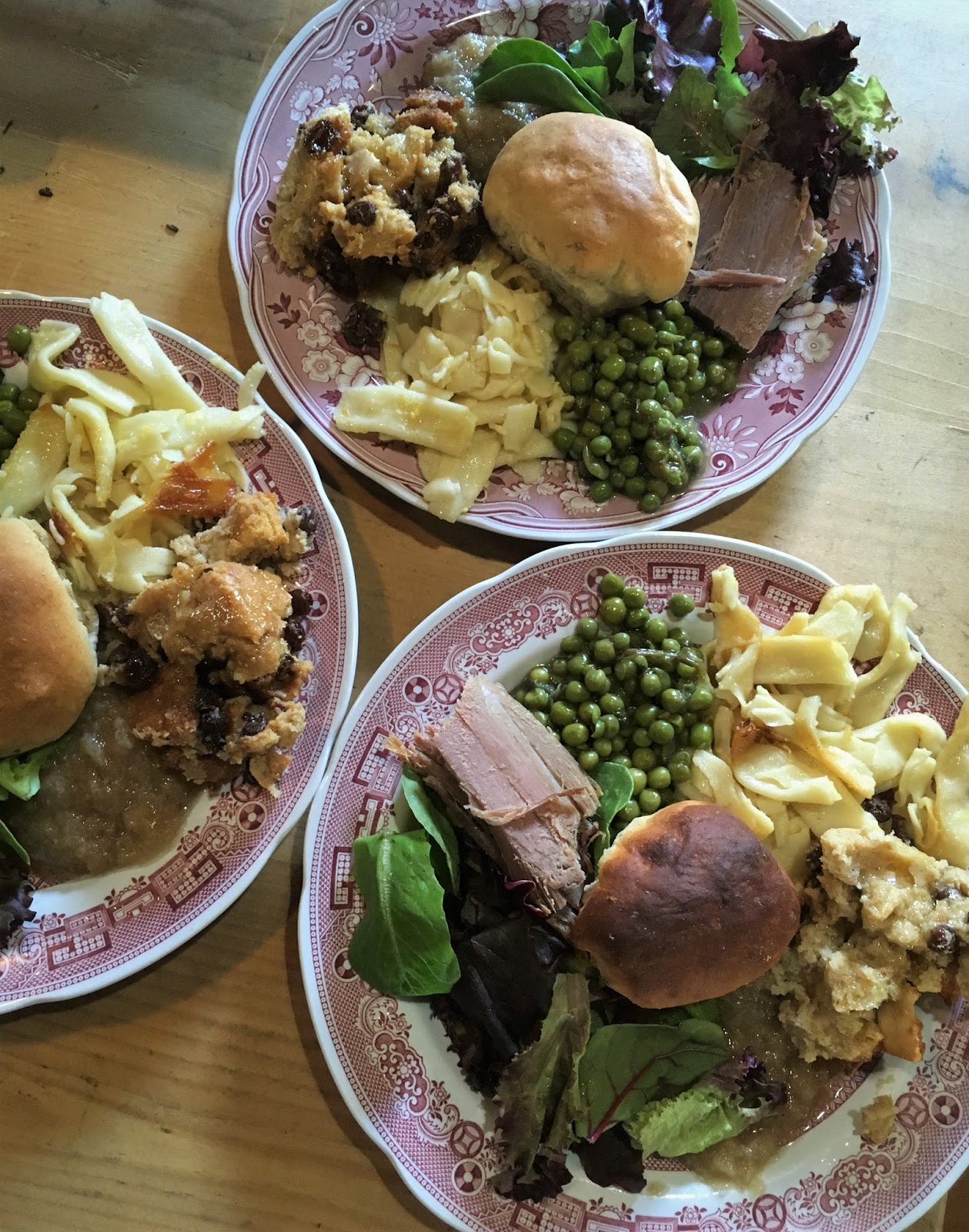
For a fourth time now, I worked at Hosmer's Inn serving the reenactor luncheon.  The twin, a.k.a. Ariana, and I, jokingly referred to as the indentured servants of Hosmer, plated lunch in the woodshed/food prep area.  Day one's lunch included macaroni and cheese, dressed peas with greens, salted ham, apple sauce, salmagundi with the special Hosmer dressing, pickled beets and spicy East India pickles, and a "plain bun" with either cherries or caraway seeds.  For dessert there was bread pudding with a brandy maple sauce - yum yum! 

Lunch, day one.

The day ended with a little shopping, and the annual tradition of talking the twin, Ariana, into buying lots and lots of pretty fabrics!  What can I say?  Regency Revisited AND Fashions Revisited were there!  

My purchases for the weekend included two yards of the be-a-u-tiful indigo stripe,
a yard of the white sheer with green dots/stripes, and two pairs of clocked stockings
(to twin it up with Ariana, of course!  Matching socks are our thing.)

There was also a small, low key soirée that night at the Inn.  Met four new folks from Maryland that were very kind and very knowledgeable, and I hope that they all plan on returning next year.  Lively conversations late into the evening with a general air of friendliness.  I'll try to take pictures next time...


Sunday, June 25th - Event Day Two


Back to Hosmer's Inn for a second day of plating lunches!  Today's menu included a potato and carrot mash, stewed beef with gravy, asparagus, applesauce, salmagundi with the Hosmer house dressing, pickled beets and spicy East India pickles, and "plain buns" or whole wheat rolls.  For dessert, there was left over bread pudding with the brandy maple sauce or gingerbread and seed cakes.  All of it using 19th century receipts or recipes, prepared onsite with our own ham and beef, and very, very tasty! 

Lunch, day two.

We couldn't have done it without Pamela, historic cook and volunteer, and the "Canadian ladies" Bonnie and Norma who prepare most of the meal in the historic kitchen at Hosmer's Inn!  

Bonnie and Norma preparing yet another refill of the popular salmagundi dish.

As a whole, I was very pleased to see some familiar faces over the weekend, including Lisa and the Meryton Assembly Dancers, as well as another Lisa and her little "B."

The most ADORABLE picture ever!
Lisa & little B.

And had the pleasure of making new acquaintances, including meeting Lydia Fast of Regency bonnet fame!  (Aaahhh I met Lydia Fast!!)


Finally, it wouldn't be 1812 weekend without a few shenanigans with the twin...this year we kept it pretty tame with picking roses at Shaker, but just wait until next time ;) 

Oh Ariana, you're so cute!

After packing up the dress shop, Rhonda and I had one last dinner together.  Then, saying our good byes, parted ways.  And, with that, 1812 weekend was over...'till next year!   

The dressmaker and I.


Regency Mourning Resources
 
  • Regency Mourning - Published on the blog, Jane Austen's World, this article details several customs surrounding mourning and the appropriate dress throughout the Regency period.  It also provides several web links for further study. 
  • Dressing for Mourning in the Regency - This article from the Jane Austen Centre provides in-depth descriptions and period sources for understanding full and half-mourning wear.  
  • Mourning Becomes Her: Regency Mourning Dress & Customs - From the Risky Regencies blog, this post discusses mourning fashion within the "Death Becomes Her" exhibit that was displayed at the Metropolitan Museum of Art in New York City, and gives a great overview and history of mourning customs during the Regency Period. 

We ❤︎ Our Patrons

Like what you see here, and want to support future blogging and educational programming? Consider becoming a Patron - click on the button below to unlock exclusive content, bonus blog posts, and more! Every contribution makes a big difference, thank you!