
 |
| A woven study in primaries and co-primaries. |
"New Beginnings" is the theme for this post, and the reason is two-fold. One, it's another semester with new classes, including three studios and a composition class. Two, I'd like to resume the monthly, college fiber-related class updates, which ended up being only a single post last Fall...(eventually I'd like to finish those, but we'll see what time allows). For the Spring Fiber Updates series, you can expect to see projects from two, "special topics" classes - Draping for Theatre II and Textiles: Color & Weave. If you're interested in what's currently on the sewing table, loom or even in the dye pots, make sure to follow the blog (or our Facebook page), so you won't miss an update - let's get started!
Draping for Theatre II: Period Draping
Is this the perfect class for my interests, or what?! A brand new, "special topics" class this Spring, designed as a part II to Draping I (which I wasn't able to fit in my self-designed program), the goal is to become proficient at draping over period undergarments. Working with various corsets and petticoats, bustles and paniers, we are responsible for creating patterns and finished half-muslins for four, distinct time periods. Our first project is an 18th-Century Dress, based on a period reference of our choice (for undergraduates), or a self-designed rending (for graduates).
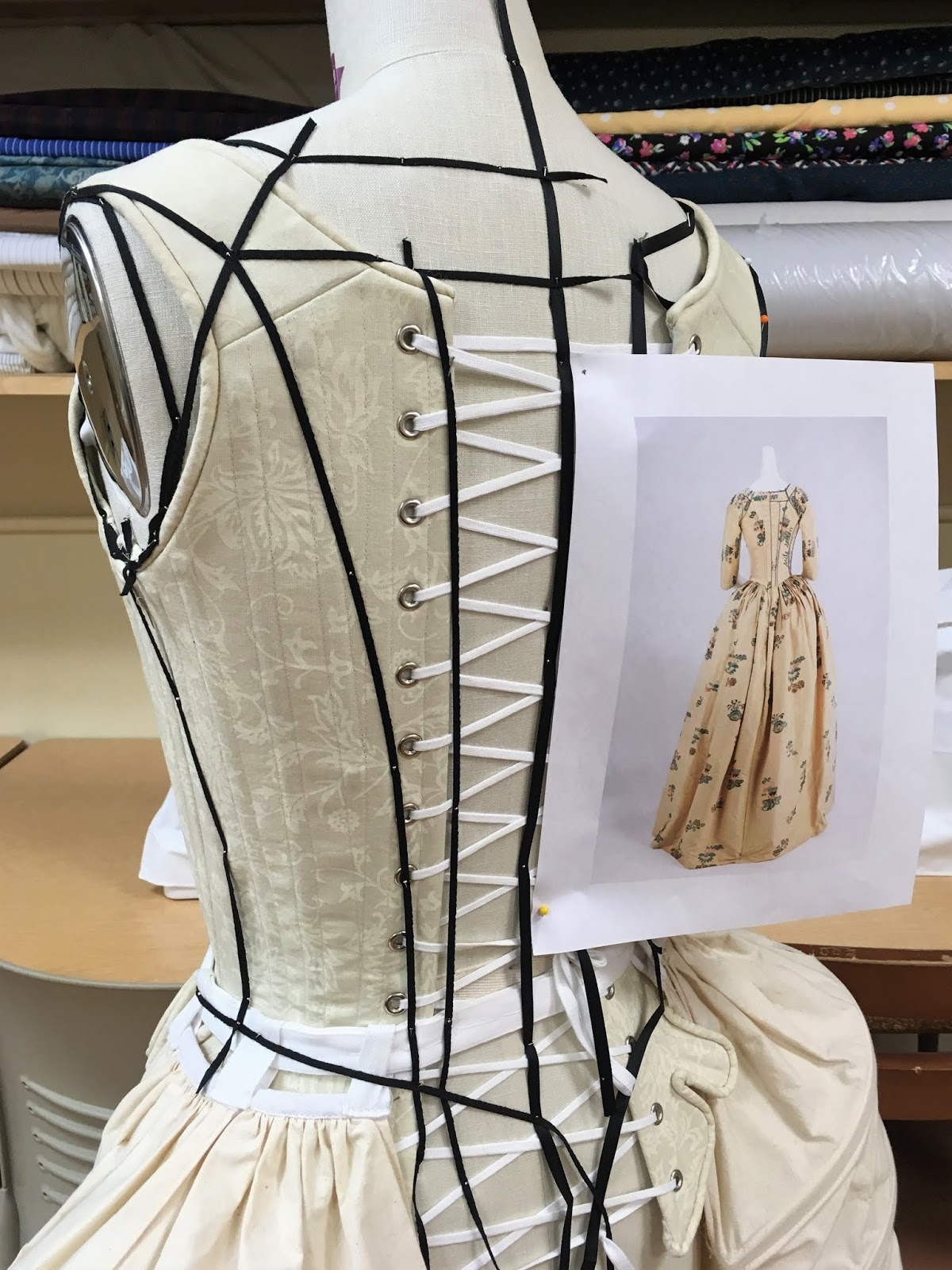
For my first foray in draping, I chose a deceptively simple Robe à l'Anglaise from the Metropolitan Museum of Art. The first step was to lay out the seam and style lines over our stays (mine were actually made during my independent study in corsetry last Fall!) and paniers. The process is very much like sketching, but with 1/8" twill tape. Since we are only responsible for half-muslins, we are sharing stands, my lines are visible on the right.
 |
| My reference image for the first project: Robe à l'Anglaise, c.1776 Metropolitan Museum of Art, 2009.300.952 |
 |
| Taping seam and style lines over stays and paniers. |
You'll notice that for theatre, pleats become seam lines to make the garments more alterable and to conserve expensive fabrics:
The next step is where the actual draping happens. First, a length of muslin was pinned and fitted to the stand, and the lines for the front of the bodice were marked. Once removed, the muslin markings could be transferred and trued up on paper. The process was then repeated for the back, completing the pattern for the bodice.
 |
| The draping process in a picture! |
 |
| Here's what my draped pieces looked like after removing them from the stand... |
 |
| ...from muslin to paper patterns! |
It's a very different technique than the flat patterning I've worked with in the past, but it's definitely a skill I'm eager to become comfortable with - just thing of all the perfectly period possibilities! Now onto the skirt and sleeves this weekend...
Textiles: Color & Weave
What kind of a semester would it be without a weaving course? Unfortunately, I had wanted to enroll in more textile studios, but both the Jacquard and the woven accessories studios conflicted with my other classes. Being that #artstudent with those looong studio classes and hours can be a juggling act, especially when it comes to course registration...That said, I did get into my first choice - Textiles: Color & Weave!
Within the first week, we were winding and dyeing skeins for our first project. A "syllabus week" simply does not exist in studio classes! In the picture below, there are 1800 yards of Crown Colony wool simmering away in pots of brilliant blue 490, turquoise 478, sun yellow 119, golden yellow 199c, bright red 351, and magenta 338, all of which are ProChemical's washfast acid dyes:
 |
| Dye all the colors! |
Then, during the second week, we threaded our looms. Though we had some parameters, like needing a minimum of a continuous inch of each color, I fun playing with some end-and-end, or alternating colored threads, in the warp:
 |
| All threaded, tied-on, and ready to begin weaving. |
 |
| A view from the back - oh and don't worry, the threads that seem out of sequence will be sorted as they go through the reed, which is like a giant comb! |
Just yesterday I finished weaving the first 20" section which included stripes of each color (with some pick-and-pick, again alternating colored threads, to match the warp) and a gradient using analogous colors. I also dyed some tints and shades for section two, which I need to go rinse after posting this!
 |
| Section one weaving in progress. The color quality isn't the best, sorry. |
Keep a look out on Facebook for more progress on this weaving, as you probably won't see it again here until it's finished.
That's about all I have to report on as far as classes go - it's going to be a very different semester from the last, where I had to eat, breath and sleep or rather not sleep sewing and weaving projects, 24/7. Though January allowed me to ease slowly back into being a full-time art student, things will no doubt pick up in February - when you can look for the second Spring Fiber Update!
Bonus: A Visit to the Kent State Fashion Museum
Since this is opening post for the Spring semester, I thought I'd share a tradition of mine...Every semester thus far, I've visited the Kent State Fashion Museum within the first week of classes to see the new extant garments featured in my favorite exhibit, The Fashion Timeline. (It also gives me a chance to catch up with some of the employees, especially the head of security and a few of the student guards, who have gotten to know me by name and face.)
 |
| My favorite and the permanent exhibit - The Fashion Timeline. This features highlights from the collection on a rotating basis. |
Here are a few of the highlights as it's too difficult to choose a single favorite: (As always, feel free to click on the images for a larger view!)
 |
| Robe a la Polonaise, ca.1770s, with linen needle lace engageantes, ca.1715-25 KSUM 2004.27.8 ab |
 |
| Silk dress with matching collar, ca. 1830 KSUM 1983.1.52 ab |
 |
| Silk plaid taffeta dress, c.1840s KSUM 1984.16.15 a-c (dress) |
 |
| Patterned silk dress trimmed with black fringe, late 1850s KSUM 1985.5.1 |
 |
| Silk taffeta evening dress with self-fabric trim and fringe, late 1860s. KSUM 1983.1.103 a-c |
 |
| If I had to choose a favorite? The details are exquisite! KSUM 1983.1.103 a-c |
This fancy dress is fun, and may be of interest to my co-workers who are awaiting the arrival of our new telegraph office at GCV&M!
 |
| Dress printed with an issue of the Ahstabula Telegraph from November 1889 Cotton dress, bag and sash; paper fan and hat, 1889-90 KSUM 2018.3.1 a-f |
A few accessories from the hallway timeline:
 |
| Ikat, is that you? I'd love to try weaving some silk ribbons in the future... Woven spoon bonnet trimmed with warp-printed ribbon, early 1860s. KSUM 1983.1.1635 |
 |
| Black leather boots with scalloped edge, ca. 1880s KSUM 1994.48.53 ab |
 |
| White leather shoes with rosettes, ca. 1880s KSUM 1998.38.13 ab |
And finally, what fun! To make the exhibit more interactive, you can now leave a "post-it" note with the "historic period [that] you wish you had lived through." Unfortunately, there was a lack of enthusiasm for anything before 1920...so I set to rectify that immediately! Readers be proud, I restrained myself to only three eras - the 1830s, 1840s and 1860s - as it is just the beginning of the semester. Though, there's no telling what I'll do at the end if this current trend continues haha...more love the 18th and 19th Centuries!
 |
| Which historic period you ask? My answer - the entire 19th century? Okay, how about just 1830-1860 for starters; then at the end of the semester, if the rest of the century remains blank, I'll be happy to fill in the timeline! |
I'll also take a turn around the current exhibits again, as something new catches my eye every time! The other exhibits on view right now are For the Birds, Fashion Meets the Body, and Beyond the Suit, which I've had the pleasure of viewing several times. The Kent State Fashion Museum is an outstanding resource to have access to, and one of the main reasons I came to KSU. I only wish I had more reason to be there (beyond haunting the fashion timeline), and would love to make a few research appointments in the future. If there are any requests for specific costumes or textiles out there - please let me know!


