Showing posts with label Wearable Art. Show all posts

November 2, 2019

Weekly Writings I: Beginnings

Trying out a new style for my blog posts with the intention of a more casual, conversational format and journal-like entries for this week's works-in-progress.  I'd love to hear what you think of the change - and if I should continue!


Monday, October 28th

I began a new passion project - an autumn 1860s dress!  This will be a "nicer" day dress of a striped, reproduction cotton with shirred coat sleeves and velvet trim on the bodice.  The goal is to have it wearable by GCV's domestic symposium if I can attend, and finished for Thanksgiving.  Not sure if either will happen, but here's to hoping...today's progress included assembling the skirt and preparing the hem facing for hand stitching. 

Materials: (top) dress fabric, (bottom) hem facing, (right) gold velvet trim.

Inspiration for bodice trim.
CDV of a young woman, c.1860s
(Image via: Pinterest, sold on Ebay) 

Shirred sleeves
(Image via: Pinterest

Another example of gathering on the sleeve.
CDV of Isa Vanfossen from Wellsville, OH, c.1860s
(Image via: Pinterest, sold on Etsy)


Tuesday, October 29th


Spent the day, 10 am - 8pm, in the textile studio.  In my dimensional class, we began our basketry samples.  Simultaneously wrapping, coiling, and stitching proved a challenge...I can see why basketry is an art!

Afterwards, I worked for my studio hours on an overshot sample.  Currently, I'm testing colors for my next, much larger project.  I dyed a four-step green gradient (ProChem's WF golden yellow + WF brilliant blue) last Friday for the pattern weft, which is crown colony 2-ply wool yarn.  The structural tabby weft is another gradient of 10/2 cottons, over a 5/2 cotton warp.  That's three separate color systems to consider - it's looking a lot like Fall on my loom!

Weft color systems:
Hand-dyed 4-step gradient of 2-ply wool for pattern picks,
(5 colors) 10/2 cottons for tabby picks

Progress on the loom.

It's almost impossible to tell, but there is a color transition
from light yellow to lime green in the structural or tabby pick.
In the next sample, I will probably make sure the color change is more dramatic.  

Plans for the rest of my night include (1) hand-stitching the hem facing, and (2) beginning my basketry project.  It's already 10pm, so we'll see how much actually gets done.  Our critique for all of the basketry samples is on Thursday, which is a crazy-fast turn around!


Wednesday, October 30th

I wrapped, coiled and stitched a thing!  It took forever and my hands will probably hurt for the rest of the week from keeping the tension...Thank goodness for Amazon Prime though - I watched all six episodes of the BBC series Aristocrats (1999), re-watched The Fabulous Life Of Elisabeth Vigee Labrun (2018), and listened to more musical playlists than I'd care to admit.  I also really, really want to sew all the 18th century things now. 

Basket in progress - here you can see I am wrapping a rope core with light tan wool,
and alternating color blocks of brown and puce-colored cotton yarns.

Here's the finished basketry sample: 


Not too bad for a first attempt, but I'm not sure I'm ready to be a basket-maker.  Bring on the circular and diamond netting next! 


Thursday, October 31st

Happy Halloween - wishing everyone a spooktacular day!

Today's #OOTD or outfit of the day featured my glow-in-the-dark spooky skirt, paired with a black and white striped shirt, clocked stockings, and pointy-toed flats.  I intended to write a blog post just on the spooky skirt (and a matching witch hat that I neglected to bring to college), but that will have to wait...so here's a preview picture or two:

Spooky Hat
(Materials: cheap velvet, wire, gauze, thread,
plastic skulls, hot glue)

Spooky Skirt
(Materials: glow-in-the-dark fabric,
interfacing, thread, metal skirt closure)

As for other class news, the critique of our basketry samples went well, and now we're moving onto netting.  Oh, and I began a figure skating class, which means of course I'm watching Olympic reruns and dreaming up skating costumes now.  Like I need more projects...


Friday, November 1st


Fridays are my textile studio days!  Not only do I have the graduate/advanced studio seminar (a meeting time for critique and discussing our weekly readings with Professor Janice Lessman-Moss), but every first Friday of the month, there's a visiting artist lecture at noon.  This week featured Wayne Gonzales, visiting artist in drawing and painting.

Afterwards, I spend the rest of the day working...sometimes I don't leave the building until 2 am, which makes for a long (16-hour!?! 10am - 2am) day.  I often do all of my dyeing on Friday nights (since I'm usually guaranteed to have the dye lab all to myself haha), but today I continued to work on sampling.  Here are the two pieces I finished this afternoon:  

Sample #5
Hand-dyed 2-ply wool and 10/2 cotton weft; 5/2 cotton warp.

Sample #6
Same hand-dyed 2-ply wool and 10/2 cotton weft
and 5/2 cotton warp as above.

The plan is to finish sampling this week, and critique at the seminar on Friday.  Then, I'll be planning and prepping for the final project.  


Tonight, I also had the chance to attend two MFA thesis show receptions!  I've had the privilege of getting to know both Nate (MFA in glass) and Erica (MFA in jewelry/metals) through a few textile courses, and it has been an honor to weave side-by-side with such talented artists.  I will miss them both, and wish them all the best in their careers and continuing artistic practices!  

Nate's glass weavings are incredible!  These few pictures of my favorites from the show do not do them justice.  To see more of his work, please visit his website here: Nate Avery Glass

Glass weaving by Nate Avery, MFA.

Glass weaving by Nate Avery, MFA. 

Glass weaving by Nate Avery, MFA.

Erica's multimedia body suits are equally inspiring and just fantastical!  Her woven pieces often feature an array of found materials, and her transformation of "trash" or plastic bags in this costume is beyond words.  On a more personal note, the textiles studio will definitely not be the same without her - she's been so kind and supportive of my own work, in class and late nights at the loom, I will really miss her.  Luckily, you'll find her and be able to follow her work over on Instagram @eurrrca

"Chaosmomalia" body suit by Erica Hoosic, MFA. 

"Chaosmomalia" body suit by Erica Hoosic, MFA.
All of that weaving! 😍 

All in all, a wonderful way to end the week.  See you in the next weekly writings! 

April 16, 2017

Wearable Art: Strange Water Stays (Part 2)

When we last left off in Part I, I had about 16 hours into the wearable art project with binding and hardware still left to install.  For the class presentation, I brought along both the recycled material stays and my mid-century corset to compare and familiarize my classmates, hopefully changing their perceptions of the "torture devices."  Based on the positive responses from critiques, I think it's safe to say that the combination of water pollution concerns and early 19th century undergarments made quite a splash!  

Strange Water Stays, completed!

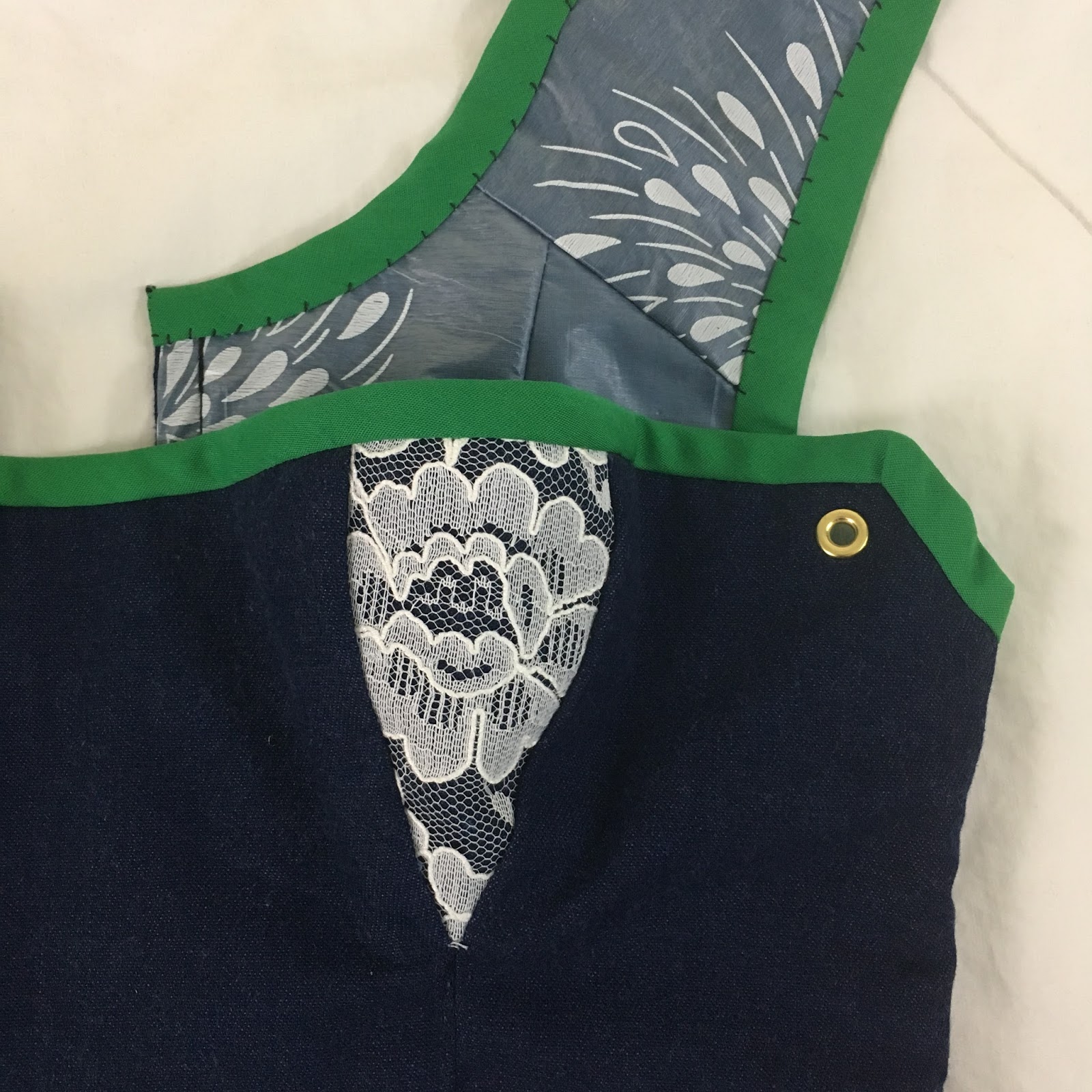
Design Concept:  From recyclable materials to wearable art, the Strange Water Stays are a visual, environmental statement.  Much as stays served as the foundation for the early 19th century silhouette, water supports our very existence and its vast bodies sculpt the landscapes of the Earth.  The dark blue denim, lace and vibrant green binding of exterior of the stays represent the beauty that is, much like our lakes and waterfront views offer.  However, the interior speaks to an unnoticed, sinister truth of death and decay lurking beneath the water's surface.  Intention and unintentional litter, like the paper, plastic and shiny metal products representing unnatural pollutants interspersed among the lily pads of the corset, silently chokes plant and marine life to death.  If we do not strive to make greater efforts to protect our irreplaceable aquatic ecosystems, polluted, lifeless, strange waters, will be the only reminder of the natural beauty that once was left.  


Completed Stays:  This project, transforming trash and recyclable materials into art, challenged me not only as a designer and artist, but technically as I had to adjust to issues that arose with the use of non-traditional materials.  (I only stitched all the way through one finger and broke one sewing machine needle in the process!)  After binding the top and bottom edges of the stays, I installed the grommets for the straps and used a pair of old shoe laces for lacing.  In the spirit of conserving resources, I decided to only place bones (aka plastic zip ties) at the center backs and save the rest of the grommets for future projects...

Outside - Shell of denim re-purposed from a skirt, lace curtain overlays and green cotton binding.  

All laid out, exterior.

Bust gusset and lace overlay detail, exterior.

Center back, exterior.

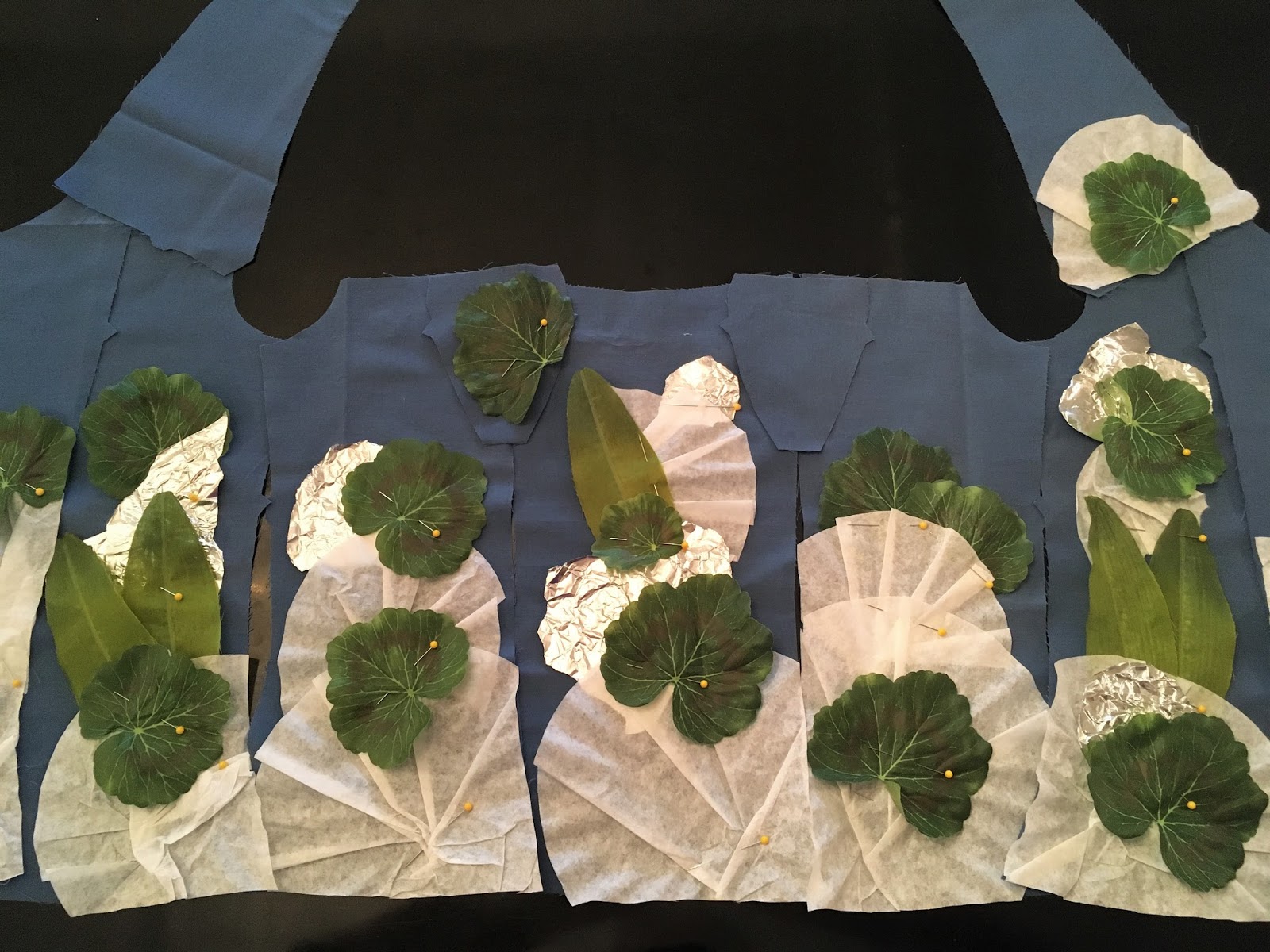
Inside - Blue cotton interlining, plastic shower curtain liner re-purposed for lining, plastic zip ties for boning, metal grommets and shoe strings for lacing.  The "pollution" included aluminum foil and paper coffee filters, and the "lily pads" were leaves left over from a plastic flower bunch. 

All laid out, interior.

Center front, interior.

Comparison -
Side view, exterior.

Side view, interior.


Strap and grommet detail, interior

Bust gusset and grommet detail, exterior.

Bust gusset detail, interior.


Strap detail, interior.

Strap detail, exterior.

While I do not foresee myself actually wearing these stays, remade in the appropriate historical materials and natural fibers, they might provide decent support for early 1800s and 1830s endeavors.  All in all, the construction time totaled about 20 hours.  

April 12, 2017

Wearable Art: Strange Waters Stays (Part I)

This semester, I decided to try something new and enrolled in a studio art class that explores the traditional and contemporary uses of the sketchbook.  The class emphasizes both the keeping of a sketchbook itself, as an essential tool in the development, practice and documentation of the creative process, and the exploration of a variety of materials and techniques.  Through a weekly series of 5-6 completed pieces of self-directed work and assigned projects, the demands are both challenging and rewarding from ideation to creation and critique.  

(Photograph via: Pinterest)

The last challenge presented to the class was transforming trash and recyclable materials into art.  We were given two weeks, and few restrictions beyond using re-purposed materials and that nothing new could be purchased.  That same class, we were instructed to brainstorm usable materials and project ideas. 

Immediately, I knew that I wanted to create a piece of wearable art.  And not just any garment, but one that made a statement.  Combining both water pollution concerns and early 19th century undergarments, the "strange waters stays" project was born! 

The initial brainstorming.

Phase two included the actual designing of the stays.  We were instructed to prepare several detailed drawings of our objects from various views and collect swatches of the intended materials to pitch to the class.


For my nontraditional, recycled corset materials, I chose to re-purpose denim from a donated skirt and lace from donated curtains for the outer layer.  I also chose to use bright green bias tape, an accidental purchase wasting away in the stash, for binding.  

Front view.  Notice that the seams and boning channels are marked.

For the inside, I selected an ocean blue cotton from the stash for the interlining, and my previous shower curtain liner, which needed to be replaced anyways, for the lining.  The "pollution" included tin foil and coffee filters, and the "lily pads" were leaves left over from a plastic flower bunch.

Interior view showing the intended construction.

More views of the stays.  Each sketch was worked in pencil, ink and watercolor.  I intended to use metal grommets and shoe strings for lacing, plastic zip ties for boning, and either a paint stick or cardboard to serve as the front busk.  


I thought that the lace overlays would add some visual interest to the outside, but also would serve as a metaphor for our lakes and waterways - scenic beauty at first glace with the sinister truth of death and decay lurking beneath the water's surface.  

Side view showing lace overlays, boning placement and stitching lines.

Back view, also showing seam and boning placement.


After our designs were presented and approved in the following class, we were given one week to assemble our projects.  Enter phase three: the construction process!  Because this was such a new experience, I did my best to document each step.  

First, I cut out each layer - lace overlays, denim outer, cotton interlining and shower curtain lining.  (Yes, I wiped down the shower curtain liner before use...)


Lots of layers!

Then, I assembled the outer denim shell, flat-lining the lace overlays to the bust gussets and side back pieces.  This was a new technique for me.


Constructing the inter lining was next.  This is where I had to get creative and adjust to the challenges of working with the non-traditional materials as they arose.  

I played around with the placement of the "pollution" until satisfied.  The coffee filters were crumpled and pleated to resemble lily pads, while wadded pieces of aluminum foil were interspersed among the "lily pads" or plastic leaves.  This represents how human litter, intentional or unintentional, silently chokes plant and marine life, forever altering those ecosystems.  Once everything is dead, such strange waters are the only thing left.  

Artistically arranging the polluted waters with paper
coffee filters, pleated to resemble lily pads, plastic leaves and shiny foil,
three types of litter that end up in our waters.   


Originally, I planned on hand tacking everything, but decided to save time and zig-zag all of the edges.  Or so I thought...this process seemed to take the longest of the steps as neither machine, nor I was used to sewing with the non-traditional materials.  Only one broken needle!  

Zig-zagged in place.

Afterwards, I flat-lined the plastic shower curtain lining to each piece, sealing the "pollution" in place and adding a murkiness to the "waters."


Assembling the lining was tricky because of the bulk in each seam.  I did my best to press the seams flat using the lowest setting on the iron and a cotton cloth to prevent any melting...


Aligning the outer and lining layers, wrong sides to the inside, I stitched along the upper edges and stitched-in-the-ditch to join several seams.  I found it very difficult to stitch through all of the rather stiff layers, so decided to skip the boning except at the back edges.  Now at the 16 hour mark, with the binding just pinned, I had completed all that I could before class...Stay tuned for the final results in part II!

We ❤︎ Our Patrons

Like what you see here, and want to support future blogging and educational programming? Consider becoming a Patron - click on the button below to unlock exclusive content, bonus blog posts, and more! Every contribution makes a big difference, thank you!