May 22, 2018

1830s Cap of Lace, Net & Ribbon

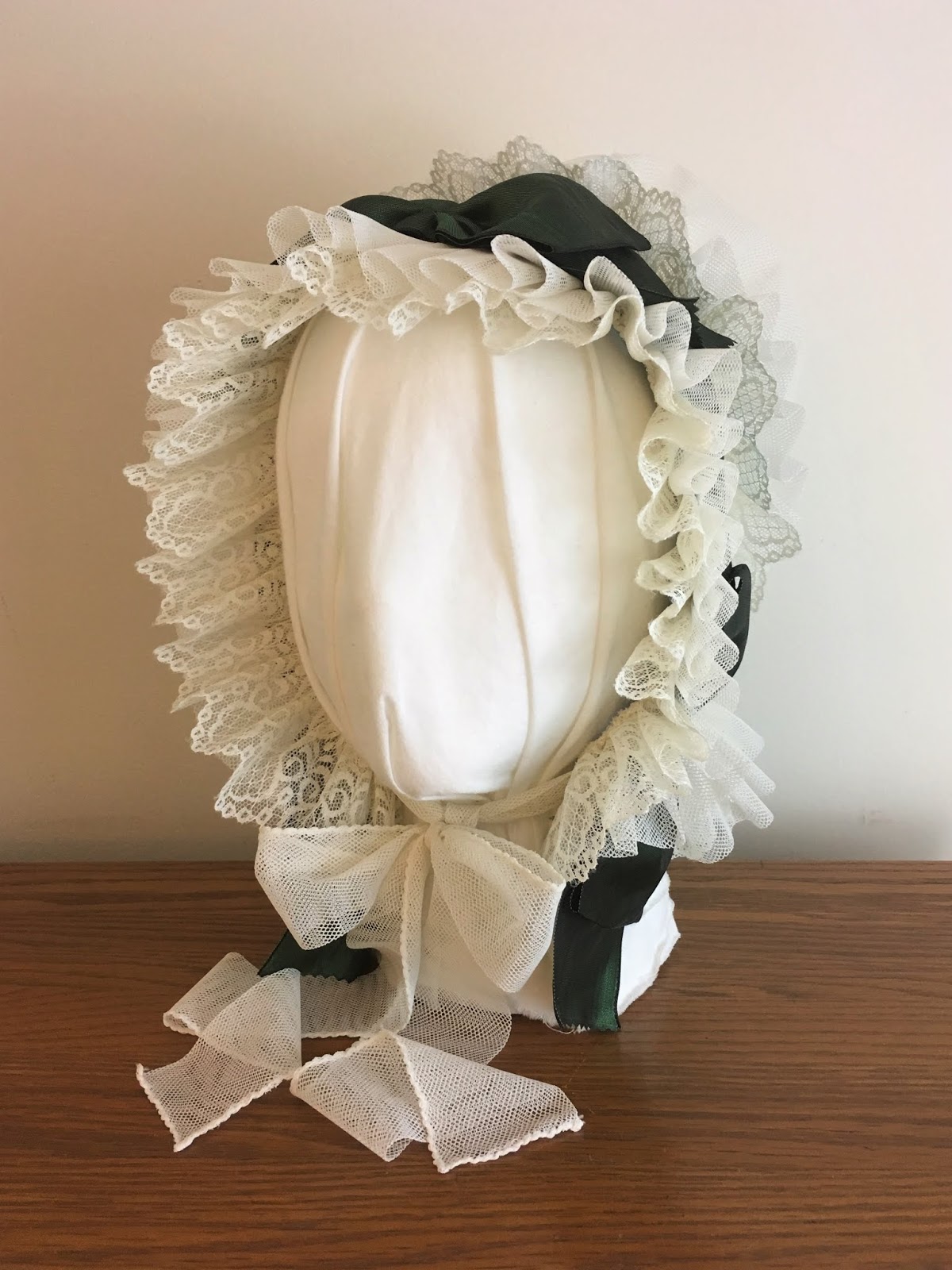
From ginormous gigot sleeves to towering Apollo knots, if there was one thing to be said about the fashions of the 1830s, having "too much" was not a concern.  Pile on the lace, the ribbons, frills and bows!  The more the merrier!  And that's just what I did for this newly completed cap:

1830s cap of net, lace and wide ribbon trim.
Tomorrow I'll be returning for my first day of the 2018 museum season, substituting for another interpreter at the Foster House.  While I enjoy the responsibilities of working in the interpretation office, there's nothing like getting to play "dress up" for a day and sharing stories of the past.  While I would have loved to have a new dress for the occasion, I decided to alter a previous creation instead and finish this confection of a cap.  In fact, this has probably become my most favorite cap to date! 


Historical Inspiration

As always, I like to look to extant examples, portraits and other period appropriate sources for inspiration.  This painting really spoke to me: 

Portrait of Alexandra Nicolai Sicily
by Christian Albrecht Jensen, 1824
(Source: Hermitage Museum, via Wikimedia Commons)

My reproduction cap.

I modeled my design after this cap from the MET:

Morning Cap, 1835
(Source: Metropolitan Museum of Art)

And got the idea to pleat the net from this:

Woman's cap of net and satin ribbon, c.1825
(Source: Los Angeles County Museum of Art)

But it was finding this extant example that really helped my design come together:

Net cap with green and yellow striped silk ribbon, c.1800-1830
(Source: Lot 66 of the Helen Larson Private Collection)

For more extant examples and other inspiration images, feel free to visit my Early 19th Century Caps Pinterest Board.  


Construction Details

If you've been following my blog for a while, you may have noticed that I make a lot of caps.  Rather than repeat more of the same, I'll just say that rolled hems and whipped rolled gathers on net are nothing like fine cottons or linens.  Net is far more finicky, and not for the faint of heart!  

In progress: the cap itself is a single layer of net finished with rolled hems. 
Both the lace and net frill (double layer made by folding a long strip in half)
were pleated, then attached with rolled whipped gathers.

Outer layers of frills attached.

The gathers ended up being a little more bulky than I would prefer due to the pleating and all of the layers.  In a few of the extant examples I've seen, the frills appear to be attached with a running stitch and then covered with a narrow band of net to enclose the raw edges.  I would explore this technique as a better alternative in the future...

Interior view of the cap.

The ties, much like the net frills, were just long strips folded in half and rolled up the sides:

Interior view of the ties and rolled whipped gathers or hems.

Exterior view.
Please note that both sides of the cap are visible.


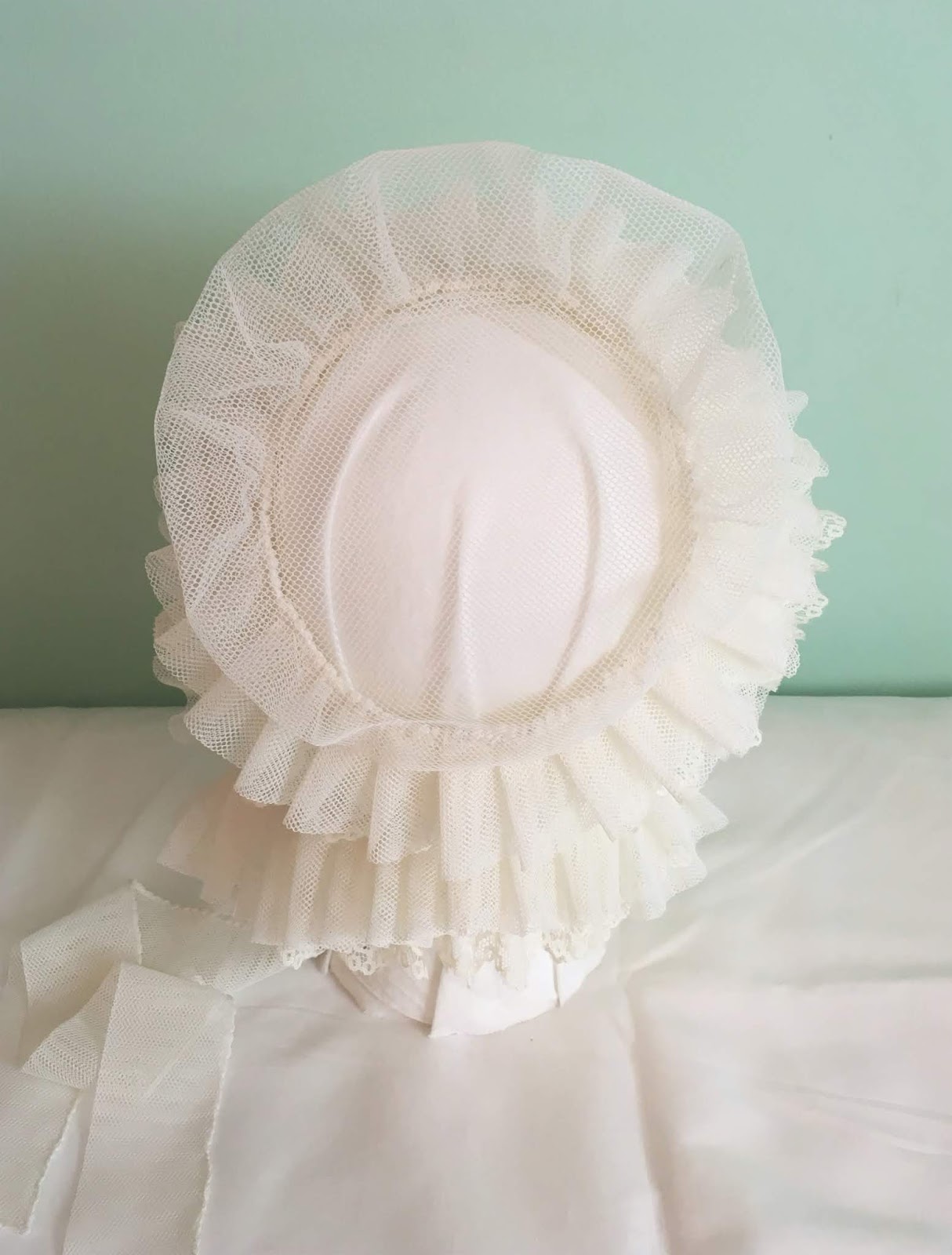
Untrimmed Cap 

Once the ties were on, I took a break to capture some pictures of the untrimmed, but finished cap.  


So sheer!  No hiding unstyled hair under this cap!


Completed Project Shots 

To complete the look, I trimmed the cap with two yards of a beautiful, wide moire ribbon from The Dressmaker's Shop. 


I think the ribbons really change the look.  What do you think? 


Thanks for reading!

May 12, 2018

Jumping Back on the Blogging Bandwagon

At last, it's summer vacation, and I am so ready for it! 

Hello blogging world, I'm baaa-ck!

This past year has been quite a whirlwind as I decided to return to college as a full time student.  For those of you who know me in person, I can be quite a perfectionist and tend to like to bite off more than I can chew, as the expression goes.  The combination of the two has left this poor blog rather neglected, and its writer feeling a little overwhelmed.  I was so focused on projects, essays and exams, I feel as though I've let any personal sewing and blogging fall to the wayside, and even fallen out of touch with many friends.  

This summer, however, offers the chance to make amends and pick up those unfinished projects and unpublished posts.  (The sheer amount of pictures and ideas for content that have amassed are quite alarming!)  While I've made peace with the fact that I'll never be able to finish everything, I am content to simply get back to writing and am jumping back on the blogging bandwagon.


Moving Forward on Blogger


I love what Ray Bradbury said: "Write what you love and love what you write."  To me, blogging is all about the personal experience.  It's a space where any individual may write about whatever makes them happy, capture memories and share passions.  We as bloggers should free ourselves from self-imposed expectations, deadlines and guilt, and instead, give ourselves permission to do exactly what Bradbury said: write what we love. 

What does this mean for the blog?  You may see me writing more about past projects and events, including a year's worth of school sewing projects.  Never fear, though, there will also be new historical sewing and living history posts too!  However, I will be focusing more on publishing finished works, and keeping the in-progress updates to other social media accounts. 


Also, a note about restoring pictures to previous blog posts: there are still many past blog posts missing pictures, due to problems with the switch from picasa to google image hosting.  Ideally, I'd love to restore all of the images, but doing so has been slow going.  So, for now, unless there is a want for a certain post (please let me know by requesting in the comments), this project has been put on hold.  


Onto Facebook & Instagram


Speaking of other social media accounts, you can find us on Facebook, Pinterest and now on Instagram too!!  I will probably be most active on the Facebook page, posting about in-progress works, events and previews for upcoming blog posts.  Pinterest is reserved for collecting research and inspiration images. 

I'm still trying to figure out Instagram and how best to use it, so please bear with me there.  Suggestions are always helpful and appreciated...


Other Summer Plans 


This weekend is the opening weekend for the Genesee Country Village & Museum's 2018 season!  While I am sad to have to miss this year, I am pleased to announce my return for a fifth season as the interpretation office assistant and historical interpreter!  If you have the chance to visit our lovely historic village, please say "hi!"

Also, my "homework" for the summer is to practice sewing.  Practice, practice, practice has been the advice of professors and fellow sewing friends (Kaela, cough cough) alike, as I know there are many areas where I need improvement and sewing confidence.  Several opportunities this semester have made a future, yet not so distant, career in costume construction and living history seem all the more real and exciting...so be on the look out for more sewing projects like these:

First project I finish when I get home!

I will make you, squiggle dress!

Almost there...

This year's birthday dress?

May 3, 2018

Extra, Extra, Read All About It!

Finally, a blog post!  It's our last week of classes here at Kent State University, with plenty of projects to finish, papers to write and exams in store for finals week...but, it's almost summer!  I have big plans, including some serious catch up on sewing, blogging and just life in general...

But first, I'm breaking the blogging silence with something very exciting: 


I'm in the newspaper!

See it online in both Mandarin and English, here:


The Erie Chinese Journal, in fact, which is a Cleveland-based Chinese (and English language) newspaper.  I believe that the article, "Designing Your Dreams" by Cynthia Lundeen, author and milliner at Cynthia's Centuries of Style, was originally released in the March edition, but I happened to come across it, just yesterday, online.  (It's amazing and sometimes very scary to see what comes up when you"google" search your name...)  

Anyways, I had been waiting to see it in print before announcing to family and friends, and heard that the package is currently waiting at my permanent address...but, having seen it published now, I can no longer keep the secret!  I am just beyond words at having had the great pleasure and privilege of working with Cynthia Lundeen and Ying Pu, publisher of the Erie Chinese Journal.  

Standing in the dining room,
Photograph by Ying Pu

The story starts back in February when I received a surprise email from Cynthia Lundeen, who I had greatly enjoyed having as an instructor for the period millinery course in the previous semester.  She mentioned that Ying Pu, friend and publisher of the Erie Chinese Journal, took interest in my chosen, non-traditional course of study, and that they would like to interview me as it could help other students find just as niche and career specific programs.  Immediately, I jumped at the chance, incredibly honored to be considered for Ms. Lundeen's next article.

Photograph by Cynthia Lundeen.
Historic home built in 1896.

Signing the guest book.
Photograph by Ying Pu

A few weeks later, we met for tea and an afternoon of talking about our passions and history, and how important the pursuit and remembrance of both are.  The historic home was beautiful, inside and out, built in 1896 and listed on the National Trust for Historic Preservation.  I even had the chance to tour the millinery parlor and upstairs work studio, which were truly where the magic happens - I've never seen so many vintage hat blocks before, or hats for that matter!  

Photograph by Ying Pu.

Playing "dress up,"
Photograph by Cynthia Lundeen

In addition to bringing what few items of historic dress I had on campus, I was happy to get to share a little about going to school for costumes and textiles, working at a living history museum, and my passion for historical sewing.  I will admit to feeling a little sheepish when talking about myself, but do hope that this article may inspire future students who are struggling, much like I was, to find a college program that meets their specific interests and career goals.  Integrated or multi-disciplinary studies programs are the best-kept secrets of colleges, folks!  

The face of glee!
Photograph by Ying Pu.

Alright, back to homework for me, and, hopefully you'll consider taking a peek at the article now.  Many, many thanks to Cynthia Lundeen and Ying Pu of the Chinese Erie Journal for the great honor and privilege of sharing my story!  

March 17, 2018

Extant Garment: 1860s Green Plaid Dress

Happy St. Patrick's Day!  For the day that's all about the wearing of the green, I thought it appropriate to share this emerald, plaid day dress from the Point Park University Collection.

Point Park University Collection - 1860s Green Plaid Dress

If there is anything to be said of Civil War fashions, they sure loved their plaids!  Type "Civil War dresses" into any image search, and dozens of examples will probably appear.  In fact, you might even come across a green plaid dress or two, as there's seemingly no shortage of examples out there.  Here are several that I found:

Hand tinted portrait.
(Image via: Pinterest)

All the Pretty Dresses, one of my favorite resources for discovering extant garments in private collections (usually shared from Ebay, Etsy or other auction sites), had three green plaid dresses:

Green and black plaid silk dress with pagoda sleeves.
(Image via: All the Pretty Dresses)

Two-tone green plaid silk dress with velvet trim.
(Image via: All the Pretty Dresses)

Green, black, white and red plaid silk dress with pagoda sleeves.
(Image via: All the Pretty Dresses)

And yet another sold on Ebay:

Green plaid silk dress with pagoda sleeves.
(Image source: Ebay - travellingbubble)

So, it's no surprise that Point Park had one of their own hidden away...until now!  The following images may be shared and saved for personal reference, but please credit the "Point Park University Collection" - thank you!


1860s Green Plaid Dress 

This gorgeous, green plaid silk dress from the Point Park Collection is from the American Civil War Era.  It was among my favorite discoveries when I was given permission to study and photograph parts of the university's collection (more details here: project background).

Unfolding the dress, front view.

Full length view of the back.

The fabric is a green, grey and black plaid silk taffeta:


The bodice is fully lined with a tan-colored, polished cotton and has a one inch waistband.  It closes with nine 3/4" buttons and corresponding button holes up the front, and two snaps and hooks at the waistband.  The topmost button is missing, and one of buttons applied on top of the trim is decorative, rather than functional.  (A third snap on the inside serves as the closure.)

The front of the bodice closes with nine 3/4" buttons and button holes.

Close up of the center front.

The center back, from neckline to the edge of the waistband, measures 15.5" in length.

Back of the bodice.

The trim is eye-catching and interesting because the black silk bias strips were first machined through the center (to conceal the raw ends), then hand basted to the dress.  Three rows of the black silk trim are applied continuously from front to back, with the bottom edge slightly extending onto the waistband in the back.  


Notice the hand basting and curved, machine stitching details.

The two coat sleeves feature wide bands of pleated black silk to form decorative puffs.  These puffs are banded down by two bias strips - one applied at the top, and other at the bottom - to hide the stitching and raw edges.  Three bias bands at the wrist echo the the trim on the bodice.

Close up of the silk sleeve puff banded down with bias strips.

The sleeve trim echos the bodice and skirt.

In looking at the interior, one of the front darts was opened, and an extra 2" extension was added to both sides of the waistband at the center front.

Interior view of bodice.

Alterations included removing one of the front darts.

The front placket or skirt opening measures 9.5" in length.


The skirt is made from the same plaid silk and fully lined in a forest green polished cotton.  Measuring around 108" in circumference, the skirt is pleated at the front and sides, and gauged only at the center back for 5 inches.  Black wool braid was applied to protect the hem.


The skirt's trim was applied in the same way as on the bodice - machine stitching along the middle of the bias strips and then hand basting on the garment.  The 1/2" bias strips were applied rather unevenly with the average distance between each strip being 1/2", and the average distance between the groups of three being 1.5 inches.

Nine bands of black silk bias trim and wool hem braid applied to the skirt hem.


Note: In looking through the university's acquisition pictures (probably take in the early 2000s), I came the matching bodice with pagoda sleeves!  There may also be a matching ball gown bodice, but, unfortunately, neither were in the box with the dress above:

Green plaid silk bodice with pagoda sleeves.
Photograph by Point Park University.

Please visit the Extant Garments page if you're interested in more collection items, and let me know if you want to see more posts like this in the future! 

We ❤︎ Our Patrons

Like what you see here, and want to support future blogging and educational programming? Consider becoming a Patron - click on the button below to unlock exclusive content, bonus blog posts, and more! Every contribution makes a big difference, thank you!